Delivery 01 · Decision Work Pipeline

You already have the rain map.
What you do not have is the decision to bring an umbrella.

Your CRM shows the rain that already fell; what is missing is someone telling you whether to bring an umbrella tomorrow, and signing their name to it.

The information is in the CRM. The team is in the field. The meetings happen every week. And still, the month's close keeps being a surprise, like deciding your week without checking the forecast, trusting only the rain that already fell.

XALQ takes on that reading the way a weather station takes on the climate: on a weekly and biweekly cadence, it delivers the quarter's bulletin for leadership (floor, likely, and ceiling), the storm-front alert on the pipeline for management, and each salesperson's own weekly forecast: the defensible sales decision, not the dashboard.

Schedule a conversation → See a sample delivery
Short answer

What is Decision Work Pipeline?

It is an ongoing revenue-intelligence operation, on a weekly and biweekly cadence. It delivers a three-scenario forecast for commercial leadership, an operational dossier for management and an individual read for each salesperson. It does not replace the CRM: it turns the data the team already logs into a defensible sales decision.

What it is

The anchor offering of the Decision Work line: revenue intelligence as an operation, not a report.

Pipeline doesn't replace the CRM or compete with it. It starts from the premise that the information already exists (the team already logs it, already meets, already discusses opportunity by opportunity) and what's missing isn't data, it's the read that turns that data into a decision that holds up to whoever is asking for it.

That's why the delivery isn't a single report. It's three distinct analytical streams, one for each function that decides something different with the pipeline: the director decides direction on a biweekly window, management decides coaching on a weekly window, the salesperson decides their own effort also weekly. Each stream is calibrated for the decision that function actually makes.

The entry point is the Pipeline Diagnosis, symbolically priced and fully creditable if the client continues into the ongoing operation.

Real result

This is the delivery ACME has received for fourteen weeks, across three distinct cadences.

Not a mock. Not an illustration. It's the operational package XALQ delivered on the morning of Monday, April 21, 2026.

ACME
Pipeline under management: R$ 4.2M · 8 senior salespeople · Average cycle: 67 days
Decision Work Pipeline · Briefing #14
Week of April 14 to 20, 2026
For the Sales Director
Biweekly forecast in three scenarios
Biweekly · holds up the defense of the number before the board
Realistic, optimistic and pessimistic forecast for the quarter. Probability of closing per opportunity above the material threshold. Analytical read of the risk of missing target. Outlier opportunities with institutional context. Strategic suggestions to hold up the number.
For Sales Management
Operational dossier of the team
Weekly · structures the coaching session
Structural health of the pipeline, opportunities in focus, loss reasons, average cycle per stage, distribution of sales across salespeople, volume of commercial activity, structural analysis per salesperson with suggestions for use in management.
For each Salesperson
Individual read of one's own operation
Weekly · input, not audit
Opportunities in focus, conversion per stage, operational cadence, interval between activities, deals with and without defined next steps, structural analysis of one's own commercial discipline, adapted for self-reading.
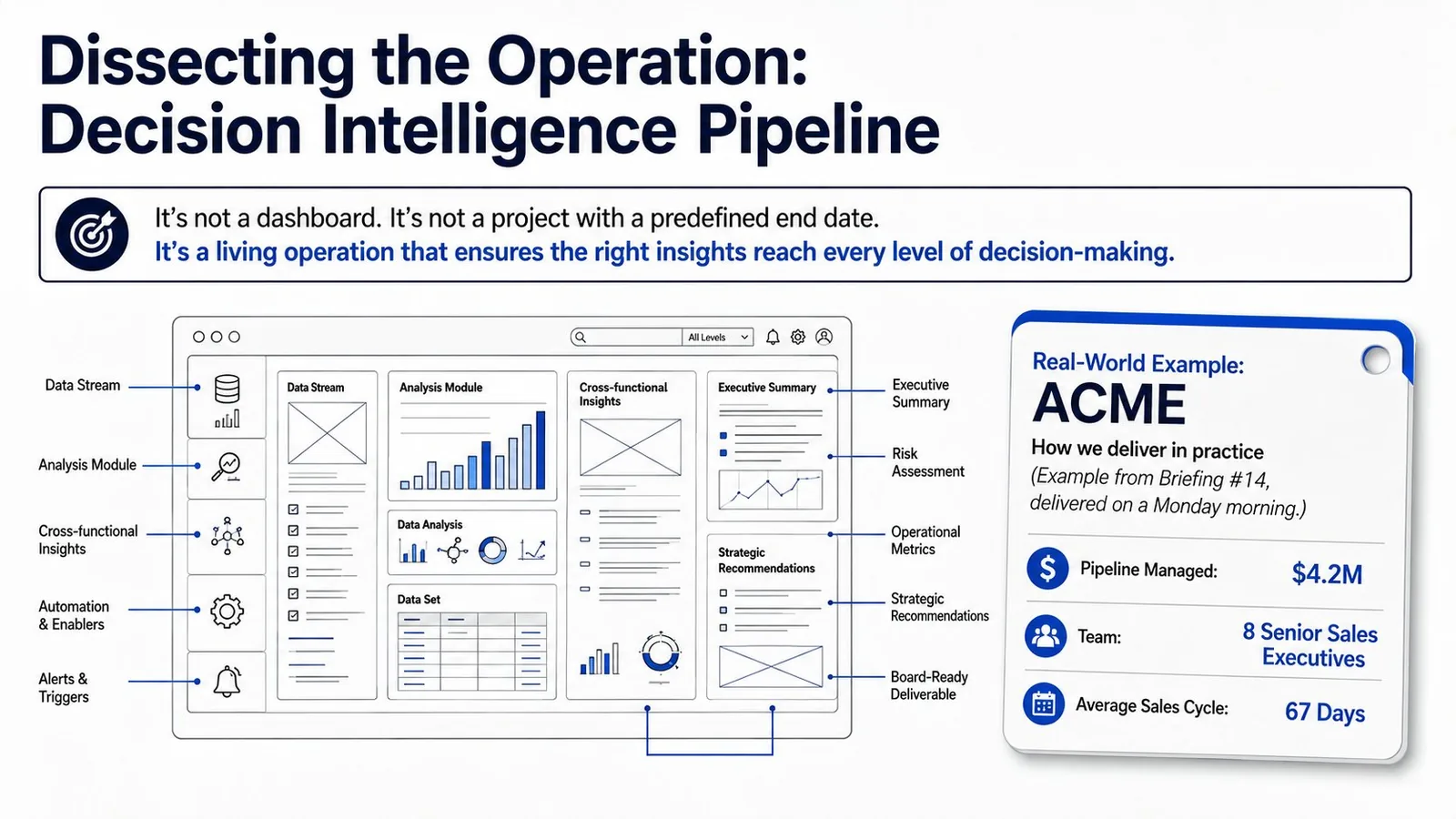
Dissecting the Operation: Decision Work Pipeline, sample delivery for ACME
We use ACME as a fictitious name to protect the confidential information of a real client.
What it proposes

To make the forecast and the pipeline read defensible, every week, at every level of decision.

So that month-end closing stops being a surprise, the forecast stops being defended with more conviction than evidence, and the senior salesperson stops carrying opportunities whose real probability no one knows how to assess.

Every serious weather service publishes its own accuracy record. We are building ours: each cycle's forecast, compared against what actually closed, on the record, not hidden once the quarter has become old news.

What it delivers
  • Biweekly forecast in three scenarios (realistic, optimistic, pessimistic)
  • Probability of closing per opportunity, above the material threshold
  • Weekly operational dossier with the pipeline's structural health
  • Weekly individual read for each salesperson
  • Quarterly institutional read with cohort and seasonality analysis
  • Strategic suggestions to sustain the number
What it doesn't deliver
  • A dashboard for the client to operate alone
  • Auditing the salesperson
  • Replacing human coaching between management and team
  • A promise of revenue growth
Three functions, three cadences, one articulated operation, sustained by a senior Business Specialist, in a human-in-the-loop arrangement, and amplified by applied intelligence.
Who it's for

Every level of the sales operation decides something different, and gets the read calibrated for that decision.

Economic buyer
Commercial Director · CRO

Whoever carries the number before the board. Receives the three-scenario forecast, the analytical read of the risk of missing target, and outlier opportunities with an institutional read: the material that sustains the defense of the number, not the hope that it closes.

Biweekly + quarterly institutional read
Entry buyer
Sales Management

Whoever runs the coaching session with the team. Receives the operational dossier (reasons for loss, average cycle by stage, sales distribution among reps) as material that prepares the analytical ground for coaching to happen with depth.

Weekly · structures the coaching session
End user · Non-buyer
Each Salesperson

Receives only their own report: opportunities in focus, conversion by stage, deals with and without defined next steps. It's not an audit, it's input to prepare their own week with more judgment.

Weekly · input, not audit
The commercial wedge
Pipeline Diagnosis

Symbolically priced (it's not a discount, it's a reduction of first-purchase risk) and fully creditable if the client continues into the ongoing operation. The real entry step isn't the "yes" in the conversation, it's access to the CRM: that's what allows delivering a real diagnosis of your pipeline, not a generic one.

From it is born, if the client continues, the ongoing operation: biweekly forecast, weekly dossier and individual read, with the same depth every week while the house's marginal cost decreases over time.

The method

Decision Work Pipeline is an operation articulated across three cadences, calibrated to the natural decision window of each function.

The operation doesn't deliver a single report distributed to everyone. It delivers three distinct analytical streams, because the director decides direction on a biweekly window, management decides coaching on a weekly window, and the salesperson decides their own effort weekly as well. Each stream is built for the decision that function actually makes.

Sales Director
Biweekly + Quarterly

Forecast structured in three scenarios (realistic, optimistic, pessimistic) for the current quarter. Probability of closing for opportunities above the material threshold. Analytical read of the risk of missing target. Outlier opportunities identified with institutional context. Strategic suggestions to hold up the number.

Quarterly, this stream consolidates into an expanded institutional read: cohort analysis of closed opportunities, quarterly conversion rate with robust statistical volume, emerging seasonal patterns, strategic recommendations for the following quarter, and recalibration of operational parameters.

Sales Management
Weekly

Operational dossier of the team. Analysis of the structural health of the pipeline. Conversion rate per funnel stage at team and individual levels. Average sales cycle. Distribution of sales across salespeople. Volume of commercial activities. Loss reasons. Structural analysis per salesperson with suggestions for use in management.

The dossier is the main material for the weekly coaching session between XALQ's Business Specialist and the client's sales management. It doesn't replace the human-to-human coaching that management conducts with the team; it prepares the analytical ground for that coaching to happen with depth.

Salesperson
Weekly

Individual report for each salesperson. Opportunities in focus with specific context. Conversion per funnel stage. Operational cadence. Average interval between activities. Deals with and without defined next steps. Structural analysis of one's own commercial discipline, adapted for self-reading.

Each salesperson receives only their own report. It's not an audit, it's operational input for the salesperson to prepare their own week with more rigor.

The rituals that consume the delivery
Coaching session with sales management
Weekly · adjusts to biweekly and monthly as it matures
Forecast review meeting with sales leadership
Monthly
Quarterly institutional meeting, with a senior XALQ partner present
Quarterly · replaces the monthly one in close months
Why it works economically

The operation gets lighter over time, without losing depth.

In the first months, Decision Work Pipeline requires a dense presence from the Business Specialist. The operation is being calibrated to your sales cycle, your products, your salespeople, your geography. The applied intelligence is learning the pattern of your operation. Coaching sessions are weekly. The analytical read is frequently revised.

Over time, the operation matures. Parameters stabilize. The applied intelligence absorbs the pattern of your operation in depth. The analytical reads become more precise with less intervention. The cadence of the rituals adjusts: weekly coaching becomes biweekly, then monthly.

The client keeps receiving the same depth of analysis. The deliverables continue with the same rigor. The quality of the output doesn't drop. It grows.

The difference is that, in the mature operation, the house can hold quality with less senior human intervention per client. That's what allows Decision Work Pipeline to exist economically: technology reduces the marginal cost per client without reducing the value delivered to the client.

It's also the reason XALQ doesn't sell projects. It sells ongoing operation. A project assumes the exit happens. An operation assumes the delivery continues, with growing quality, for as long as it makes sense for both parties.

The commitment

XALQ doesn't promise revenue growth. It promises defensible analytical quality.

The explicit commitment is to the rigor of the work delivered, not to the client's commercial performance. That's a deliberate cut, and it deserves to be said plainly.

Revenue growth depends on many variables beyond the reach of any external house: product strategy, price positioning, strength of the sales team, market conditions, the macroeconomic cycle, the client's capacity to execute on what the analytical read indicates.

What is within XALQ's reach is the rigor of the analysis. The consistency of the cadence. The depth of the analysis. The quality of the dossier that sustains the coaching. The precision of the three-scenario forecast. The defensibility of the number the sales director takes to the board.

These are the commitments XALQ takes on, and they are subject to a measurable SLA. Executive decision remains the client's. Commercial outcome remains the client's responsibility.

What changes, with Decision Work running, is that these decisions come to be made on a defensible analytical foundation, not on intuition, hope or pressure.
How to compare

Three ways to solve this, and who carries the risk in each.

Before deciding, it's worth separating what is actually being compared. A revenue intelligence dashboard, traditional commercial structuring consulting and Decision Work Pipeline solve the same pain in structurally different ways. And that, not the price, is what should decide.

Ongoing operation
Decision Work Pipeline

You are not buying a one-off report or a tool to run on your own. You are buying the signed read, cycle after cycle. And with every new cycle, the previous one stays there, to be checked against what actually closed.

When it's wrong: it shows up in the next cycle, on the record
Project
Traditional consulting

You are buying a diagnosis with an end date. When the contract ends, responsibility for the next quarter ends too, even though the market keeps changing. We also keep that option, for whoever doesn't yet have the data maturity for the next step.

When it's wrong: it's no longer the deliverer's problem
Tool
Tool + Senior In-House Hire

You buy the CRM and hire a senior person to configure it, build the dashboards and read the numbers. The read comes to depend on one person, with an executive's cost and the months it takes them to get up to speed. We also offer this option, for those who don't yet have the data maturity for the next step, with a HubSpot implementation.

When it's wrong: the risk sits with one person
Next step

If your pipeline describes what you just read, it's worth a conversation.

A conversation of roughly forty minutes, in which XALQ's senior Business Specialist understands the current structure of your sales operation and returns a preliminary read on where Decision Work Pipeline fits, and where it doesn't.

Schedule a conversation → Receive a sample dossier
FAQ

Frequently asked questions

How does the three-scenario forecast work?

Every two weeks, leadership receives the forecast in realistic, optimistic and pessimistic scenarios, with close probability per opportunity above the materiality threshold and a read on the risk of missing target. It is the material that supports defending the number in front of the board.

Does Pipeline replace the CRM or management coaching?

No. Pipeline starts from the premise that the information already exists in the CRM and what is missing is the read that turns it into a decision. It also does not replace human coaching between management and team: it delivers the dossier that prepares the analytical ground for coaching to happen in depth.

How does it start and what is the Pipeline Diagnosis?

The entry point is the Pipeline Diagnosis, with a symbolic ticket, fully creditable if the client moves on to the ongoing operation. The real step is granting access to the CRM, which allows a diagnosis of your actual pipeline, not a generic one.

Does XALQ promise revenue growth?

No. The promise is defensible analytical quality: forecast, risk reading and strategic suggestions to sustain the number. A dashboard for the client to operate alone and salesperson auditing are also out of scope. And so this doesn't become an empty promise, we are starting to record our own forecast's performance against what actually closed, cycle after cycle. It's the same standard of honesty we already apply by not promising growth.